Wednesday, 15 April 2009

The brass finger plate


There was very little that I could save from our family home when it had to be sold after my parents' death.
This filigree brass finger plate was one of the few things that I had room for.
In fact it had never been fixed to a door until we moved to our present house and I knew very little about its provenance.

One of our favourite National Trust houses is Standen in West Sussex.
It was designed in 1891 by the architect Philip Webb and decorated by Morris & Co.
We have visited it for years with our children and made friends with another family after their baby crawled over to our eldest son to make the first connection.

One day I noticed the finger plates all over the house and recognised that they were the same pattern as the one above.
They were designed by Philip Webb.


On our Easter Monday visit, the house was crowded and as the sun obligingly shone for the late afternoon, 
we spent all our time in the 12 acre hillside garden and woodland with the friends we first met there fourteen years ago.

Sunday, 12 April 2009

Happy Easter


'There was a parcel addressed to Mr, Mrs, and Miss Garland.
Inside there was a flower-embroidered table-cloth for Margaret...

and a box containing six Easter eggs.
There were three chocolate eggs, covered with silver paper, a wooden egg painted with pictures round the edge, a red egg with a snake inside,
and a beautiful pale blue velvet egg lined with golden starry paper.
It was a dream.'

The Country Child - Alison Uttley

Saturday, 11 April 2009

Miss Flora McFlimsey's Easter Bonnet


A Little Princess by Frances Hodgson Burnett and Flora McFlimsey 
by Mariana were two of my favourite childhood stories, 
but it was only today that I realised what they had in common.

They had both known happy times, had fallen from favour and then,
when it seemed they could not be more forlorn and forgotten,
they were wonderfully rescued by Magic.

And each time, there was a trunk.

Sarah Crewe's trunk was filled with 'velvet dresses trimmed with costly 
(sable and ermine) furs, and (Valenciennes trimmed) lace dresses, 
and embroidered ones, and hats with great, soft ostrich feathers, 
and ermine coats and muffs, and boxes of tiny gloves 
and handkerchiefs and silk stockings' 
and of course, Emily.

'She was a large doll, but not too large to carry about easily; 
she had naturally curling golden-brown hair, 
which hung like a mantle about her, 
and her eyes were a deep, clear grey blue, with soft, thick eyelashes 
which were real eyelashes and not mere painted lines.'

Emily was dressed in clothes 'every bit as grand as Sarah's own.'

She could have been Flora McFlimsey who, 
when she was taken out of a long white box tied with satin ribbons
 that first Christmas, was wearing a blue velvet dress 
with a hat to match and a muff of ermine fur and a tiny gold locket and chain.
She too had a trunk containing among many other beautifully illustrated things, 
a tiny lace handkerchief, a little bottle of eau de cologne, 
a pair of white kid gloves, a lace parasol and an Easter bonnet.

Both trunks had pivotal roles in what would now be called their coping strategies.
Sarah was able to summon the Magic to turn her attic room into a banquetting hall 
using just the remnants of her old life, some lace handkerchiefs,
 tissue paper and an old summer hat.

Flora Mc Flimsey remembers her glory days when her new owner takes,
'an odd little hat with two stiff feathers, 
some flowers and a bit of ribbon on it' 
out of her trunk.
She too is transported by Magic to an earlier life.


What's in your trunk?


I'd have to have 4711 Eau de Cologne in mine.

Friday, 10 April 2009

It was a dull and drizzly day


so I decided to stay in and make

a batch of fairy cakes, a loaf of bread and the dough for

these hot cross buns.

And while I was at the window,
 I watched a pair of blackbirds gathering material for the nest they were building
in a nearby tree.

Thursday, 9 April 2009

The peg bag


I have never used this beautifully embroidered vintage peg bag apron
for its allotted purpose.
My rather scruffy pegs would sully it.

Its pristine condition suggests that no one else thought their pegs good enough for it either.

It set me thinking about the ideal washing line scenario-
and on the subject of drying clothes I can do no better than to quote Cheryl Mendelson from her book Home Comforts.

'When I was a girl, hanging out the clothes was an art widely understood in the countryside...the rules were so clear that I remember one elderly lady stifling unseemly giggles when she saw the work of a novice. If those days ever come back the instructions below will save you from social humiliation.'

'If you are line drying indoors, be sure to shake out the clothes vigorously before hanging them. This is necessary to reduce wrinkling and helps them to dry less stiffly since you have no breezes to soften them.'

'My suburban friends tell me that you still need a private backyard to line-dry your laundry unembarrassedly because many people think that their neighbor's laundry flapping in the breeze ruins the appearance of the neighborhood and will complain when they see it.'

'Line drying outdoors produces appealingly fresh-smelling clothes and linen, 
and sunlight is a natural sanitizing and bleaching agent.'

'Make sure that your line and clothes-pins are clean. Wash the line, if necessary, with some ordinary detergent in water or household cleaner. Make sure it is sufficiently taut, strong and secure that there is no danger that the clothes will drag or drop.'

'The best weather for line drying, if you have the choice, is warm dry, and sunny with a moderate breeze. You need some wind to billow wrinkles out of the fabric and hasten drying. Line drying can seem interminable on a humid, airless day.'

'But avoid extremely windy days.
The flapping is wearing on the clothes; the wind is hard to work in and sometimes blows clothes off the line.'

'Remember that clothes dry at very different rates. 
If you are short on line space, run out to check on the clothes periodically to see whether some are dry. Sheets dry very quickly in the breeze and take up lots of line. You'll soon be able to take them down and hang up other things.'

'Sheets: Fold the sheet hem to hem, then fold three to four inches of one hem over the line and pin at both ends. Pin the corners of the other hem a few inches inside the other two. The sheet should open toward the wind so it blows out like a sail.
Run your hands down the selvage edges to smooth them and make sure that the sheet is hanging square and even.'

I see.
How not to do it.
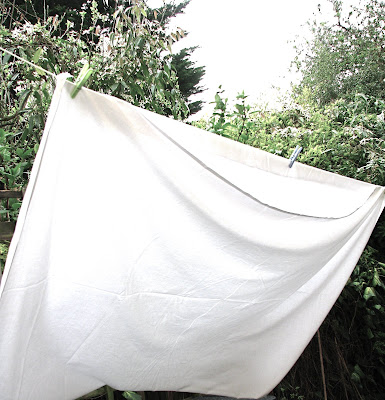
Better?

Wednesday, 8 April 2009

Tulip soup


No tulips were harmed in the making of this soup.
Serving suggestion only.

Tuesday, 7 April 2009

A few words from my sponsor

on my birthday


Simplicity of life, even the barest, is not a misery, 
but the very foundation of refinement; 
a sanded floor and whitewashed walls and the green trees, 
and flowery meads, and living waters outside
William Morris

and jugs and cake

and a decent camera

to record the passing days
(approx. 20,000 of them).